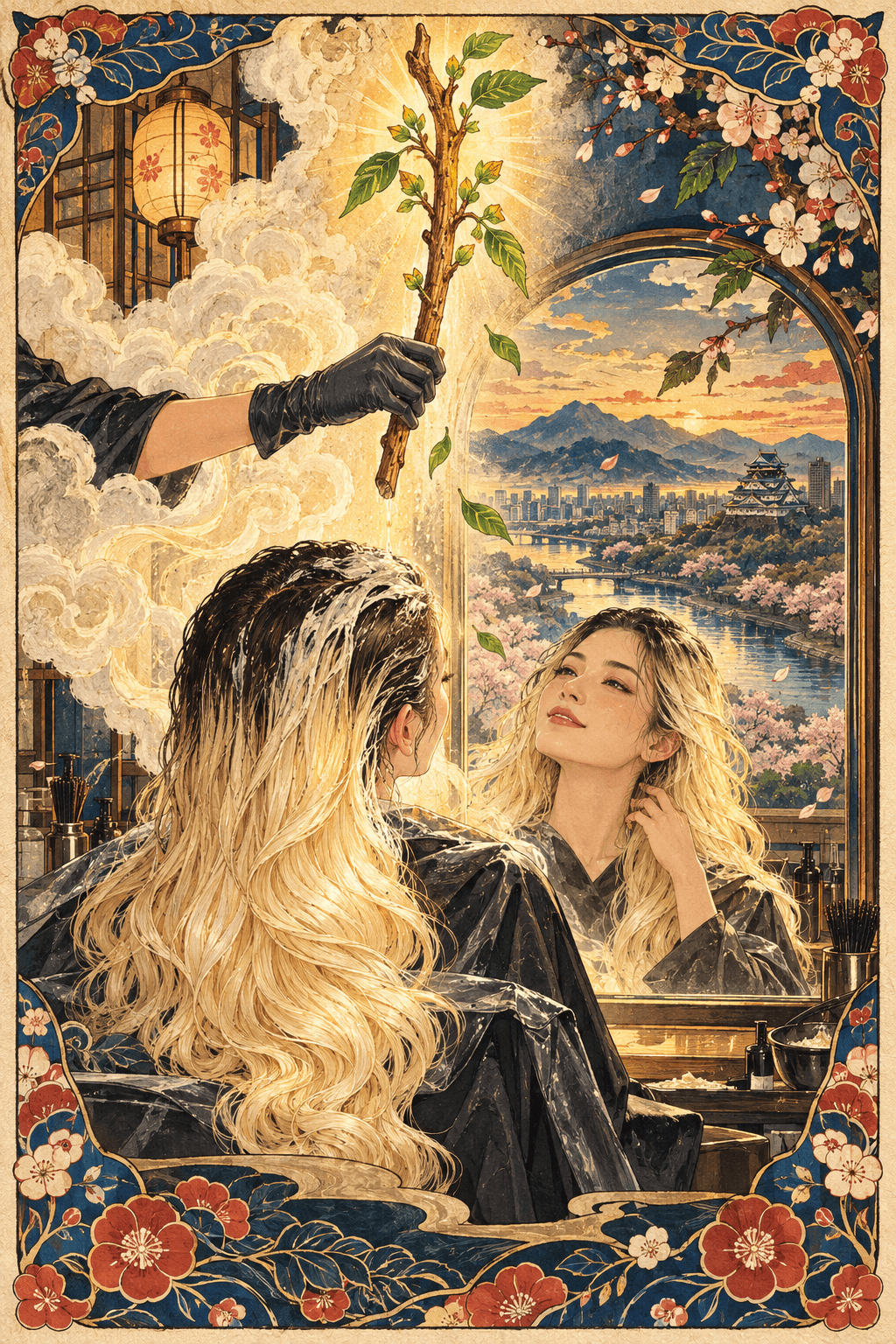
Japan is full of cosplay, and anime is crowded with characters whose hair comes in every colour imaginable. Walking through the streets of Japan, I am always seeing people with all manner of light-coloured hair. On top of that, everyone online says getting your hair done in Japan is cheaper than in Taiwan. I had been walking around with overgrown dark roots for some time, so of course I was itching to do something about the black part.
The trouble is that I always wait a year or two, until my hair has grown out a great deal, before bleaching it again. That makes the process more technically difficult, and the risk of breakage where the old and new sections meet is also higher. Hair colouring tests a stylist's eye; bleaching tests a stylist's technique. Bleaching also depends on the chemical formula used by each salon. For someone like me, who does not always go back to the same place, the colour makes it very easy to see just how different one salon's formula is from another's.
Before choosing a salon, I looked online for recommended stylists. The ones who speak Chinese and are also said to be good at what they do tend to be the same few names again and again. Being able to communicate in my own language was obviously a major advantage, but as far as I could see, their specialities were colouring and cutting. Granted, anyone who colours hair will normally bleach it too. But still~as I have already said, bleaching depends heavily on technique and chemical formulas. I contacted one of the Chinese-speaking stylists recommended online and showed her the length and colour of my hair. She replied: the black section of my hair had already grown very long and was also very dark; bleaching products in Japan were less powerful, so my hair might need two or three rounds, and whether it could be done successfully would have to be assessed in person. My courage promptly deserted me.
I personally have my doubts about the claim that “bleaching products in Japan are less powerful.” At least in Taiwan, when I go to a Japanese-style salon, two rounds of bleach leave my hair lighter than the same two rounds at a non-Japanese-style salon. That is not to say I thought this stylist was making things up. My guess was that her salon simply used a gentler formula. After all, whenever I am unhappy that my hair has not gone light enough, the same explanations come spilling out of the stylist's mouth: they are afraid it will break, they want to protect the hair, so they will not use anything too strong⋯⋯ But I like light-coloured hair! Japan's streets are full of pale shades, even outrageously light cosplay-like colours. How on earth do people get them that way? So I went to Hot Pepper Beauty, billed as Japan's largest platform of its kind, and searched for bleaching. Sure enough, up came salon after salon showing sample colours so light that they were practically platinum. Of course~~if you want an effect that extreme, you really do have to find a salon that specialises in bleaching. I went back and forth between several salons, checked that none of them was too far away, and finally looked at the first-time customer offers. I chose the most expensive coupon of the lot. Bleaching is simply not something for which you risk your own hair just to save money.
My appointment was set for October 2. Following Google Maps, I managed, very smoothly, to walk into the wrong building again. By sheer coincidence, there was also a hair salon on the fourth floor of that building. I stood staring at its name for a very long time⋯⋯it was not the name of the place I had booked, was it?? After locating myself on the map over and over again, I worked out that the correct address had to be in the building behind it. Luckily, I had not actually walked into the wrong salon. That really would have been embarrassing! The stylist “designated” by my coupon had twelve years of experience in hairdressing, which made me think he might be the manager. I did not quite dare to ask, of course, partly because my Japanese was too awful for me to manage the question. So I simply decided he was the manager. When he saw that I was a foreigner who could not speak Japanese, he took out his phone and had me add him on LINE so we could use LINE's live translation. But LINE's translations were still not accurate enough, and I immediately grew eager to try something else. Ha! This was the moment to use ChatGPT's legendary live interpretation feature! For reasons I still do not understand, ChatGPT went completely round in circles and spectacularly fell apart! The first two exchanges between Chinese and Japanese went reasonably well, but halfway through it suddenly ran wild and began speaking German. On several occasions, I had clearly said very little in Chinese, yet its Japanese went on and on at length. I had no idea what it was saying and no control over the content at all. That experience immediately killed my idea of using ChatGPT for live interpretation in meetings with Japanese companies. I had better behave myself and find a human interpreter after all.
Back to the bleaching. Once it was confirmed that I did want my hair bleached, the manager handed me a form about my hair quality to fill in. The second sheet looked like⋯⋯a warning and liability waiver? It informed customers that bleaching carried risks, and that if they were unhappy with the colour or their hair was damaged or broke, any negative comments they posted online might result in a visit from the salon's lawyer. My heart tightened for a moment. Did that mean this salon got sued all the time, or was it simply Japanese-style caution? The manager himself kept lifting sections of my hair and studying them. Through the translator, he repeatedly explained that my hair had not been bleached at their salon before, that the chemical formula would be different, and therefore that the colour could not be made uniform. The older hair was also badly damaged where it met the new growth, so further bleaching carried a high risk of breakage! I repeatedly told him that I knew the colour would not be uniform. I showed him the darker and lighter sections of my hair, both results from different salons. I knew about the risk of breakage too, but I was placing my hopes in the manager's technique. If it really did break all over the place, I would simply have to accept it. Then I would obediently cut everything off and grow it again from the beginning. The manager kept agonising over it, and I kept assuring him that I would take responsibility for the risk myself. If he did not want to take that risk, however, I could settle for just having my hair cut that day. One last time, the manager asked whether I truly wanted it gold. Me: Yes. I want my hair to be a very light colour. The manager: Apart from bleaching, do you want anything else done? Me: Just bleach. No colour, no perm, plus a conditioning treatment. Did hearing that I would not colour or perm it afterwards put the manager at ease? Did that persuade him to give it a try? (Or did cutting alone simply bring in too little money?) He gave me a new quote. I agreed without hesitation, and he began preparing the chemicals.
In Taiwan, salons normally apply a protective barrier to the scalp first, and Japan was no exception. The manager sprayed the barrier on rather than painting it on, though, and he did not colour the roots. Once the barrier was sprayed, he applied the bleaching mixture directly. In Taiwan, stylists normally wrap the treated hair in metallic sheets resembling aluminium foil. This Japanese salon used sheets resembling non-woven fabric to hold the chemicals instead. At the point where the new and old sections met, Taiwanese stylists would normally leave a fairly generous gap and treat it separately. From what I could see, this Japanese manager left almost no special gap at all. He seemed to use the same chemical mixture too. The only difference was that the sheet beneath the hair was unlike the non-woven sheet above it and looked more like plastic film. Being extremely short-sighted and unable to wear my glasses while my hair was being bleached, I could not see many of the details clearly. In Taiwan, my hair colour would normally require two rounds of bleach. To keep the gap between the processing times from growing too long, two people would often apply the product together. This time in Japan, however, there was only the manager. He worked slowly and unhurriedly, and I have so much hair that covering my whole head takes a long time. I was already beginning to worry in secret: if the colour came out uneven, surely it would not be uneven from left to right⋯⋯would it?
Bleaching takes a great deal of time, so when the manager originally told me it would take at least five hours, I honestly thought that sounded impressively fast for two rounds. It turned out I was wrong. My hair was bleached only once. After it had been rinsed, the colour was the lightest result I had ever achieved from a single round in my life. Looking at the obvious difference between the two sections, I was delighted and worried in equal measure. I was delighted because I loved how light the colour was, and it had taken only one round. If I lived in Japan, I would absolutely come back to the manager every time! What worried me was that Japanese stylists apparently did not take differences in tone into account the way Taiwanese stylists generally did, trying to keep the colours from ending up too far apart. Then again, perhaps the formulas made the difference harder to control. It was the first time I had ever seen such a sharp break between the upper and lower sections. What was I going to do? And then, once my hair was dry, the difference that had worried me miraculously faded until it was almost invisible. All that remained was a whole head of the precise degree of gold I loved. In that moment, I was so moved that I wanted to burst into tears. God, this golden hair was the colour in which I recognised myself. It was nothing like the result of my last two rounds of bleach in Taiwan, which had still left me with a gold that was heavily yellow. Getting my hair done in Japan really was cheaper than in Taiwan as well. To show my gratitude, I bought a bottle of the salon's special shampoo from the stylist and immediately booked another bleaching session before I returned home in December. It is unbelievably difficult to possess the colour you actually love. I swear I am going to delete the contact details and salon information for my previous stylist in Taiwan. The one imperfection was that, because the roots had not been specially coloured, the dark section at the top of my head was fairly obvious. You never get every good thing at once. For my first experience of having my hair done in Japan, the fact that the join had not broken and the colour was one I loved already left me deeply grateful.
Really, bleaching is still something best left to a salon that specialises in it.
讀者留言