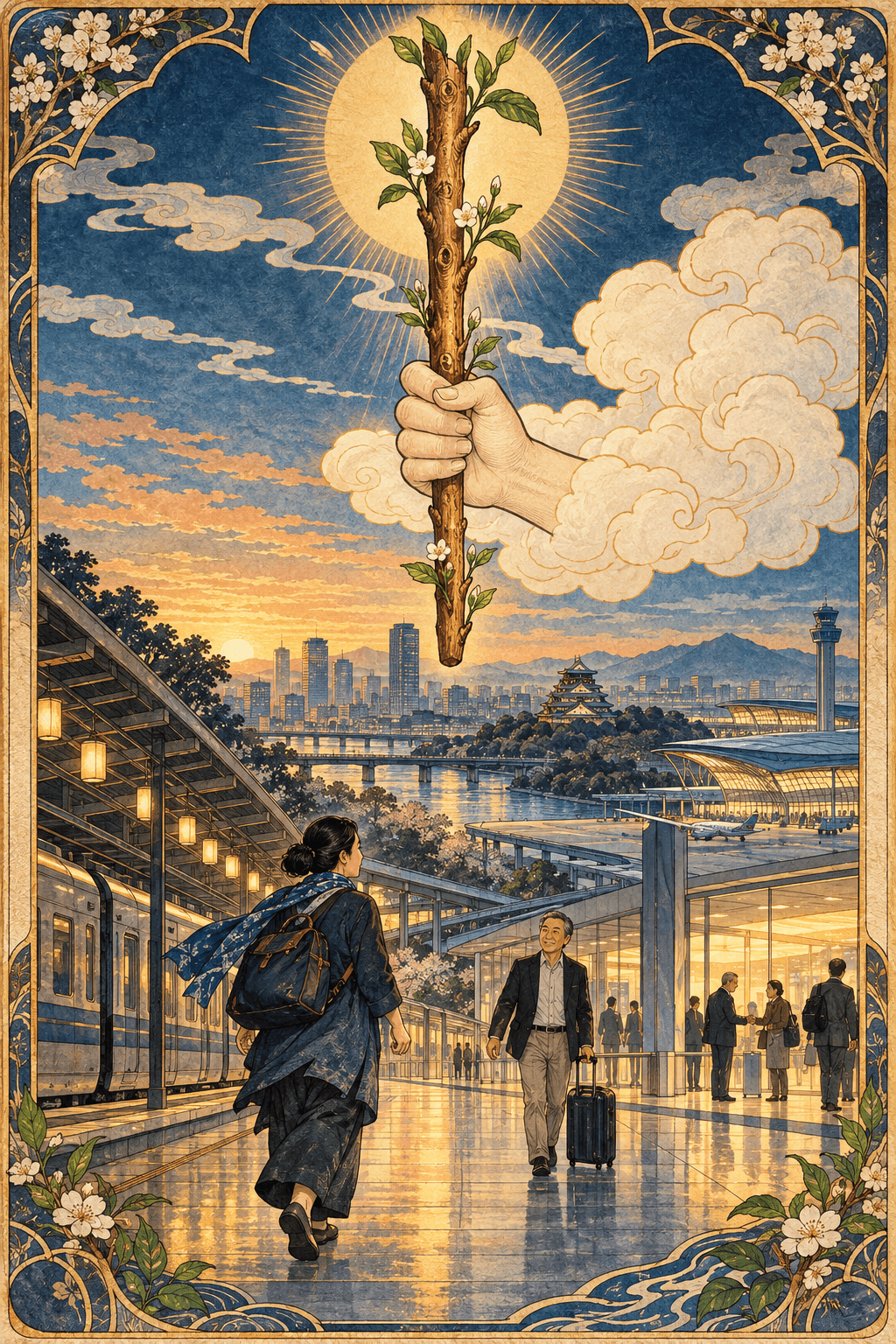
Twenty days ago, when I arrived at Kansai Airport in Japan and went through the entry procedures, there were quite a few people, yet everything went remarkably smoothly. I was even able to take a train into the city half an hour earlier than I had originally planned.
My husband left Germany yesterday to join me in Osaka. His flight was due to arrive early in the morning, and I had booked a limited-express service scheduled to reach the airport one hour after he landed so that I could meet him.
Meeting him meant getting up early, and I had not slept well the night before either...
On my way to the Nankai trains at Namba, I casually checked the flight arrival and departure information.
I saw that the flight originally scheduled to land at 07:15 had been delayed and did not touch down until 07:27. Oh, then that was all right, I thought. We had enough leeway; neither of us would have to wait around too long.
There was a plaza in front of the Nankai railway building. I saw three or five homeless men asleep on concrete benches, wearing only the clothes on their backs, with neither blankets nor even small throws covering them.
I had been to Japan so many times before, but perhaps because I had usually come on holiday and therefore had no reason to get up early, I had never encountered homeless people.
Thinking back, I truly could not recall ever seeing anyone without a home in Japan.
I had heard that Osaka had poorer districts and areas with worse public safety, yet I had not expected to see people from the lowest stratum of Japanese society in Namba.
I had assumed they generally kept themselves well hidden and would not appear where crowds gathered.
After living in Osaka for twenty days, though, I felt that the city had become livelier than it was when I visited in the past.
Yet its former "Osaka flavour" seemed to have changed as well.
I could not say precisely what had changed. I only had the feeling that Osaka's face was gradually growing blurred.
After I entered the Nankai railway building, the wall of screens showed numerous trains marked as airport limited expresses. One of them was due to depart at almost exactly the same time as the service I had booked.
My husband messaged me then to say that he was going through immigration and customs.
I asked him whether there were many people that day as I continued towards the departure platform.
Once I reached the platform, I lowered my eyes to look for the carriage-number signs, but searched everywhere without finding the carriage I had reserved.
That struck me as strange. This did not seem like the Japanese way of doing things, did it?
I checked back and forth, then confirmed my ticket once more. When I discovered that the train at my platform departed two minutes apart from the time printed on my ticket, my heart gave a sudden thud:
Could I have come to the wrong platform?
Five minutes before departure, I hurried to the correct platform. After I had boarded and settled into my seat, a message arrived from my husband: he was already standing in the airport arrivals hall.
My God, it had taken him less than half an hour from leaving the plane to clearing the arrival procedures.
My train in Namba had not even set off yet!
That kind of speed truly gave me an entirely new understanding of airports.
I did not attend language school today, but we had arranged an in-person meeting with the first company to reply to my enquiry email.
The founder had studied in the United States, but because that had been some thirty-odd years ago, he was not confident in his spoken English and had us find an interpreter; even so, he still spoke English whenever he possibly could.
Only when he perhaps felt that he could not express enough would he switch to Japanese.
Even then, there were moments when I genuinely was not 100% certain whether the other side understood the message we wanted to convey.
The consultant did, however, stress to us that when dealing with Japanese companies, building a personal network and a sense of trust mattered above all else. Once a relationship existed, everything became easier to discuss; at the same time, meeting in person was vastly more important than holding an online meeting.
I was a little surprised that Japan could place such weight on networks of personal relationships.
His suggestion that we make contact with more Japanese companies made me think: ha, that could become a very good reason for me to remain in Japan longer.
First, though, I would have to solve the problem of not getting enough protein or meat.
At my age, eating too much starch really does leave me feeling unwell.
讀者留言