Today's main event was Kyoto's annual Jidai Matsuri. Unfortunately, Takuya Kimura was not among the performers.
Only after reading the introduction did I learn that the Jidai Matsuri had its beginnings with Heian Jingu Shrine. Although it is the youngest of Kyoto's three great festivals, it already has a history of more than a century. In principle, I suppose I could understand it as Japan's equivalent of a temple fair?
At the outset, the Jidai Matsuri began as a commemoration of Emperor Kanmu's transfer of the capital from Nagaoka-kyo, today's Mukō City, to Heian-kyo.
Yet no matter how I heard it, the name Emperor Kanmu sounded familiar to me. For a while, I thought he was one of Japan's famous Three Great Vengeful Spirits. After looking it up, I discovered I had remembered the wrong person, but Emperor Kanmu's relocation of the capital did indeed have something to do with escaping the resentment of his younger brother, Prince Sawara.
So perhaps the impression in my mind that Emperor Kanmu was entangled with a vengeful spirit could still, just barely, be described as “not quite right, but not so far off either”?
The moment one steps out of the eastern gate of the Kyoto Imperial Palace grounds, one can see the shrine across the road bearing the name “Sugawara-in Tenmangu.” That name looked familiar to me as well. Wasn't he another vengeful spirit? Do places with a long history simply accumulate resentment more easily?
The Jidai Matsuri grounds were so crowded that the mobile network dropped out and could not be used. When I looked it up after returning home, I found that Japan's Three Great Vengeful Spirits were Sugawara no Michizane, Taira no Masakado and Emperor Sutoku.
As the oldest of those vengeful spirits, Sugawara no Michizane may be described as ranking first among Japan's Three Great Evil Spirits. Sugawara had already been a man of immense learning in life. Once enshrined, he was transformed into the god of learning, the principal deity now worshipped at Tenmangu shrines throughout Japan.
It was only after looking it up that I learned Sugawara no Michizane's former residence is the present-day Sugawara-in Tenmangu Shrine beside the Kyoto Imperial Palace.
Seen through the numerical principles of the Chinese Five Elements, perhaps the curse upon the Imperial Palace had more to do with the feng-shui position of the old Sugawara residence, and with its location directly facing the palace, than with the sheer force of his resentment alone, XD.
The Jidai Matsuri procession proceeds from the Meiji Restoration backwards through time, all the way to the early Heian period.
Perhaps it was because the imperial loyalists of the Restoration were the victors who created Japan's new era, but there was no Shinsengumi to be seen in the procession?
Appearing in the procession were the figures and occupations most representative of each era. The participants set out from the Kyoto Imperial Palace grounds in the clothing most characteristic of that particular age and walked slowly to Heian Jingu Shrine.
Watching the ceremony, I was suddenly struck by the thought: no wonder Japan has a cosplay culture! The Jidai Matsuri is essentially an annual convention for historical costume play.
Europe, by comparison, also has cultural gatherings at medieval markets. Yet a parade such as the Jidai Matsuri consciously presents the evolution and traditions of its own national history. To me, it has an extraordinarily powerful effect in consolidating national consciousness and national identity, while also exerting a tremendous appeal as cultural marketing to the outside world.
Most of the performers, moreover, belong to independent civic associations formed by local residents. The costumes worn in the procession have also reportedly been subjected to historical research by scholars, rather than being fantasies fashioned solely from personal imagination or preference.
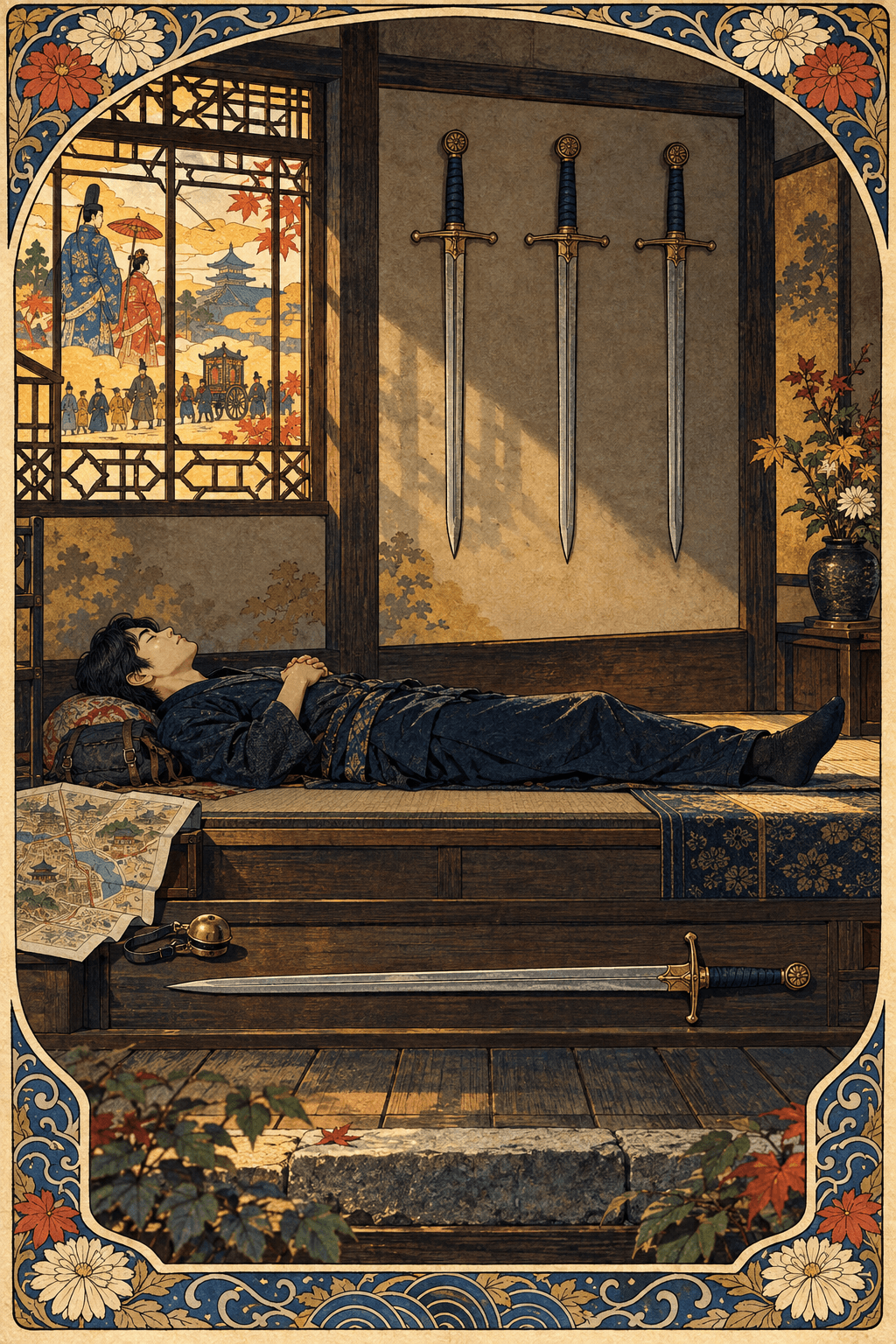
The detail of the Jidai Matsuri does not end with its clothing. As the periods change, it is not only the garments that evolve; the props or weapons carried by the figures change with the times as well. For instance, what the public now knows as the Japanese sword once took the form of a straight blade rather than a curved one.
After seeing several festivals, I suddenly understood why so many people in Taiwan speak of Taiwanese temple fairs and Japanese festivals or Shinto ceremonies in the same breath.
It is because the origins of these Japanese festivals are all connected with the worship of deities. I suppose I was simply poorly informed and had lived to this age before coming to understand more about Japan.
Compared with the bustle, vitality and firecrackers of Taiwanese celebrations, Japanese festivals are relatively quiet and refined.
If you asked which kind I prefer, though, that would genuinely be rather difficult to decide~
I like the vitality, warmth and sense of participation in Taiwan's temple fairs.
Yet Taiwanese temple fairs often lack a certain “texture,” beginning with the historical research behind the costumes. Everywhere there is a sense of cheapness and casualness, of doing everything in whichever way saves the most money and costs the least.
Even when a Japanese festival is merely a celebration of ordinary people, its quality begins with the clothing. The garments may not be made from exceptionally fine or expensive materials, but at least one's first impression is not that they are cheap rush jobs.
At a celebration such as the Jidai Matsuri, even Nishijin textiles and Kyo-yuzen are reportedly involved in producing the costumes. Visually, this makes the difference in the quality of craftsmanship between Taiwan and Japan even plainer to see.
After the Jidai Matsuri, I had an appointment with the real-estate agent to view properties, so I hurried off to meet them.
As someone who often gets left and right mixed up, I unsurprisingly turned the wrong way again. Yet sometimes in life one can simply go along with a mistake. I noticed a bicycle rental station nearby, so I went to rent a bicycle first.
I rode and rode, only to run into traffic controls before I had even gone a few hundred metres. The agent must have been quite unfamiliar with festival events, because they did not even know that traffic controls were in place. Still, it is often through moments that “were not anticipated in advance” that one can observe a person's ability to organise and plan.
In private, this agent was probably a good-natured, easy-going and friendly person. Several of the properties they showed us happened to be near Kitano Tenmangu Shrine, so the agent also took us there for a little sightseeing along the way.
From a manager's perspective, however, if this agent were my employee, I would feel that they still had many professional abilities to strengthen and train.
Japanese homes may be described as inexpensive, but prices have also begun to rise in recent years. As with prices in Japan more generally, that rise has offset the weakness in the foreign-exchange market. I wonder whether this may be a sign that “cheap Japan” will soon disappear.
Yet employment wages in Japan do not seem to have grown in step with rising prices, so I can readily understand the pressure on ordinary people's lives. So what, in the end, does that mean for buying a home in Japan?
Unless one is prepared to wager that Japan will turn itself around and soar twenty years from now, if it remains mired in this kind of lost era, then Japanese property really cannot be considered a store of value.
At the same time, I also noticed that large numbers of ethnic Chinese seem to have entered the real-estate brokerage market recently. People from China have withdrawn because of government restrictions, and the main sales focus has now shifted to Taiwan and Singapore. It is quite an interesting phenomenon.
Yet should this be regarded as some kind of warning sign for the market?
讀者留言