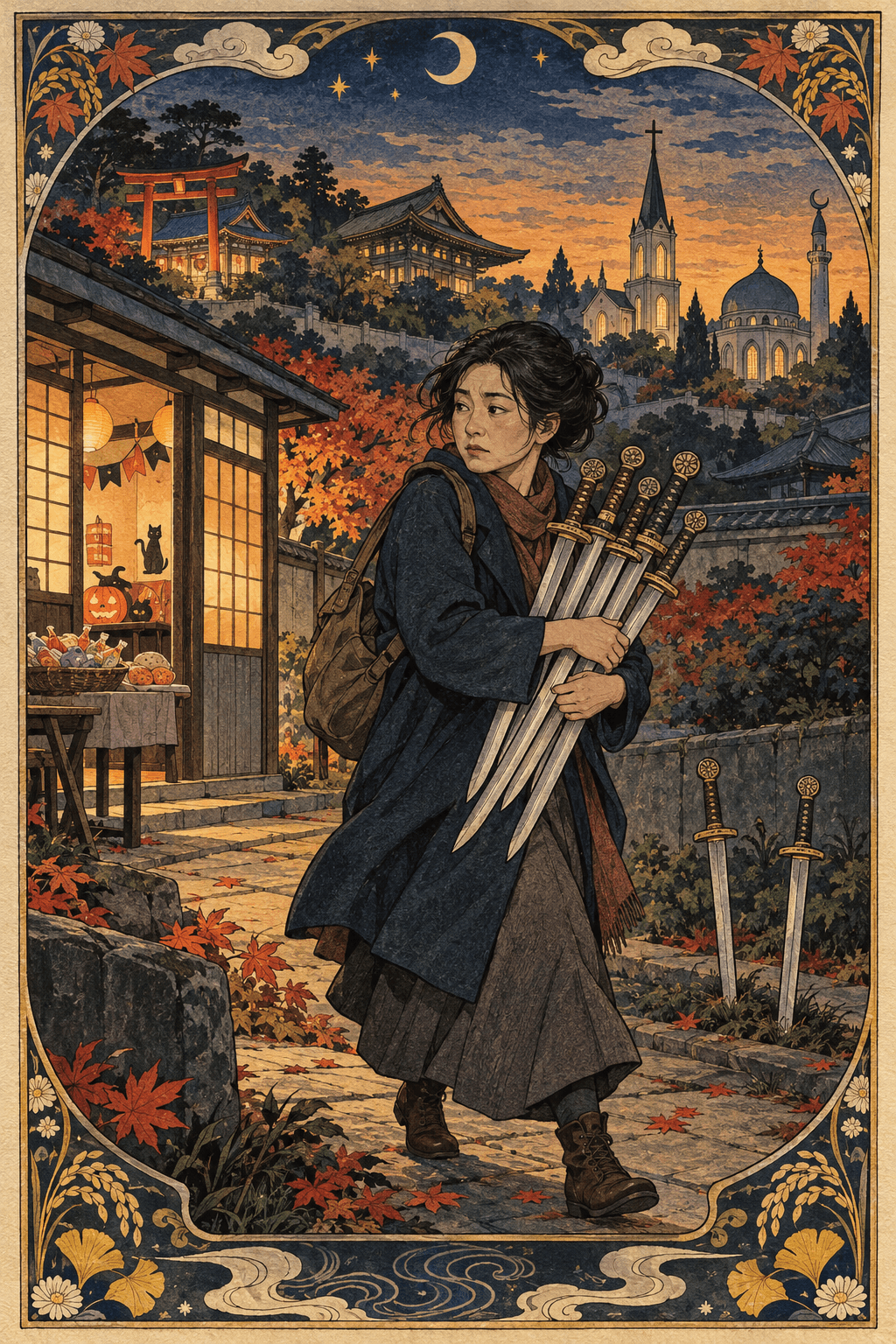
On the eve of Halloween’s eve, the school held a Halloween event, and after class the teacher handed out candy and snacks.
Among the snacks were rice crackers. A Muslim classmate from Bangladesh held up his phone and used “Google Translate” to check whether the ingredients in the crackers were halal and safe for him to eat.
I had originally said, rice crackers are made of rice; they do not contain meat!
Still, just to be safe, I looked at the ingredients. Ohhh—the label said that the production line also handled products containing peanuts, nuts, pork, and so on.
That meant they were not quite halal enough after all!
For a devout believer, one truly does have to be especially cautious in a land of other faiths!
This made me think of something else. Among the Buddhist temples and Shinto shrines I had visited, I truly could not recall seeing more than a few people in headscarves coming to look around; worshipping would have been even less likely.
Of course, perhaps there had been Muslims among the many visitors. Secularization may simply have made it impossible to recognize their religious faith at a glance from their appearance.
So many folk customs in Japan have also grown around Buddhism and Shinto. As a “wanderer” with no absolute religious faith, I enter every religious place with respect and observe the rules of the faith practiced there. Yet it is also true that I have never set foot inside a mosque.
The first time I personally felt the existence of “religious conflict” was when I was a child. An uncle of mine, who had always been in poor health, encountered Christianity before undergoing a life-or-death operation. The surgery later succeeded, and he felt the holy grace of God so deeply that the whole family was baptized and became devout Christians.
That was when the adults began saying among themselves: they were no longer willing to hold incense.
As a child, I did not understand. I wondered: what happens if they do not hold incense?
One year, perhaps during Lunar New Year or some other seasonal occasion, everyone followed custom and went to worship Tudigong. My uncle’s family was there as well. My two cousins wore looks of contempt. I did not know whether they thought those of us who worshipped with incense were foolish and superstitious, or whether they believed that venerating heresy was a grave sin.
I no longer remember what they said then, or what I said in reply. I only remember them laughing and fooling around, snapping the incense sticks and handling them with contempt as though they were rubbish.
After I entered high school, I once found myself talking with a classmate, perhaps about moving house. My classmate mentioned what had been done with the family altar and ancestral tablets. I no longer remember the details, but because my own home had no ancestral tablets, curiosity and ignorance led me to ask: what happens if there are no tablets?
My classmate answered furiously: then there is no one to worship the family’s ancestors!
I must have been wearing an expression that said, “Huh?” I thought: I do not know my own family’s ancestors at all, either, and yet nothing seems to have happened to me.
Buddhism is also a powerful force in Taiwan. Besides warning slogans such as “The Kingdom of Heaven is near” that are often pasted on utility poles, one also frequently sees or hears exhortations urging people to become vegetarian.
A few years ago, I even saw a whole row of signs tied along a street in Taiwan declaring that the earth was about to be destroyed because human beings ate meat.
I have also met Christian visitors who treated temples and other religious sites as a form of cultural experience. Some, out of curiosity, might hold incense or try casting jiaobei. The person explaining things beside them would often say with a smile: it is all right, just treat it as an experience and give it a try!
The degree of religious tolerance reflected in the words “It is all right, just treat it as an experience and give it a try” is truly astonishing. Especially for religions devoted to a single supreme deity, that very attitude of simply trying it out may itself amount to blasphemy against their God.
Over the past decade or so, propelled by commerce, the religious aspect of Halloween has increasingly come to resemble a costume party: people dress as demons and ghosts, parade through the streets, and hand out candy.
I could see that some of my classmates, because of their faith, felt uneasy about the worship of devils.
I often find myself thinking that, besides comforting the human heart, faith also widens the distance between one person and another.
讀者留言