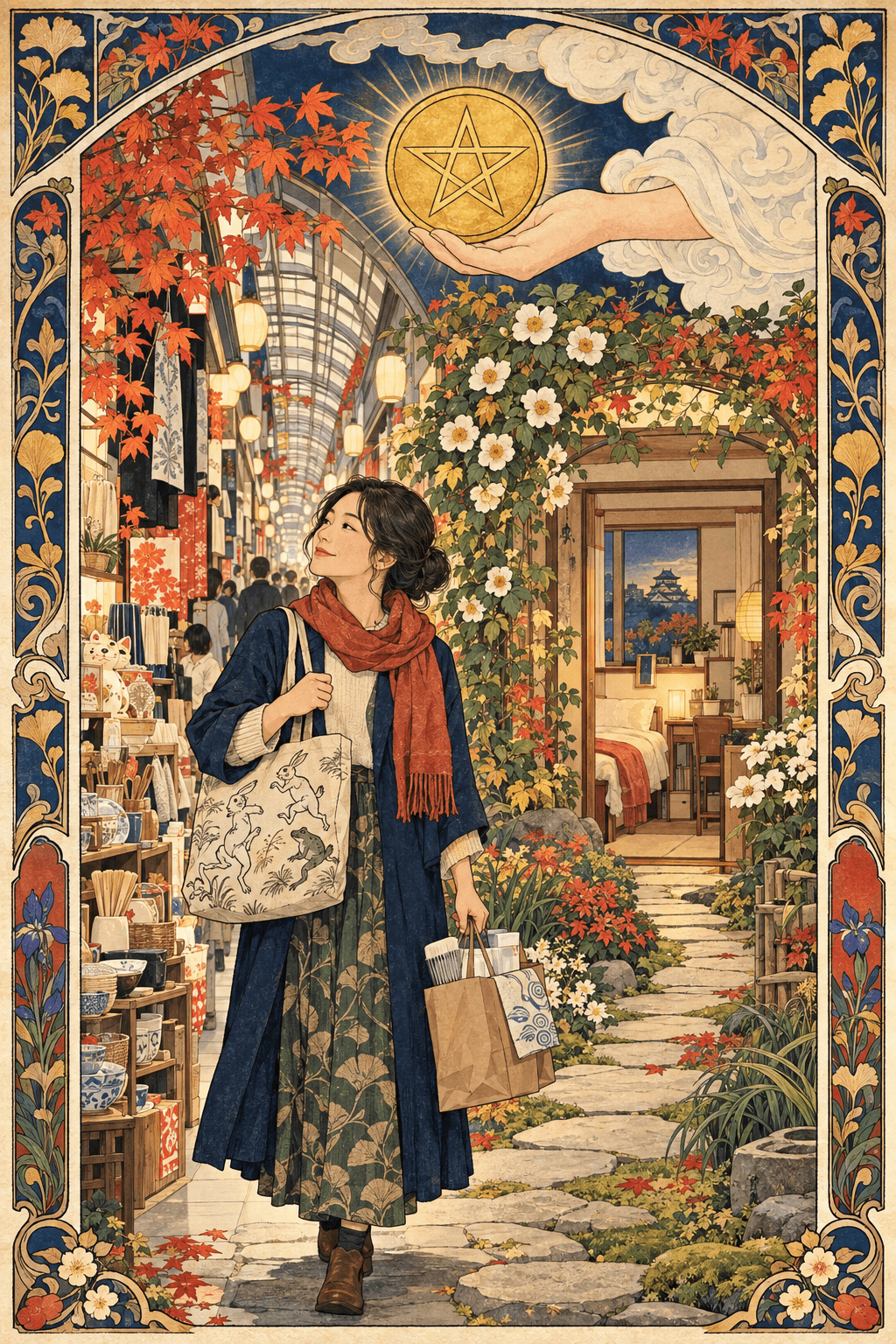
Living alone in a dormitory calls for all sorts of little accessories. Though, truthfully, I was hungry and wanted to find something to eat along the way, so I ended up strolling all the way to the Shinsaibashi area.
That evening, plenty of cars with their mufflers removed went roaring through the streets. I thought the guys driving cars like that were juvenile and stupid. Only later did I learn that the Hanshin Tigers had a game that day, and when they clinched the championship, fans really did run off to jump into the Dōtonbori River.
If it was fans celebrating, then fine. Turkish people in Berlin also form very noisy motorcades when they get married.
I had been to the Shinsaibashi shopping arcade many times, and it was as crowded with tourists as ever. I had meant to go to Sushiro for conveyor-belt sushi, but then I realised I was not actually all that hungry. I might eat two or three plates and leave, and for some reason that felt a little embarrassing.
I thought I could simply buy a natto rice ball, have a quick bite, and go straight on to my shopping. But the convenience store had no natto rice balls left...
Then I spotted Marugame Seimen. I actually rather like their noodles, and the ordering process is simple enough that you need not worry even if you speak no Japanese. Yet just as I was walking in, I noticed another place next door called Tsurumaru Udon Honpo, selling much the same things. My feet changed course and carried me into this shop, which had almost no customers at all.
It was so deserted that I wondered whether the place might still be on break.
I ordered beef udon. Honestly, it did not taste markedly different from Marugame; only the fried chicken was a little too dry.
After eating, I wandered around and discovered that several shops were either preparing to relocate or preparing to close. One shop where I had bought kimono accessories and bags several times was also holding a huge relocation sale.
I am the typical sort of person who loves buying bags. Whenever I see one that is beautiful or interesting, I want to reach for my wallet, even though in everyday life I only ever carry the same few. But in this Japanese clothing shop, I found a bag printed with Chōjū-giga, the Japanese National Treasure, and I could not stop myself from buying it.
The quality of the things in this shop is not especially consistent, perhaps because most of the people passing through are tourists, and many of its products are made in China.
This bag, however, had “Made in Japan” written on its label. I picked up each of the three display samples and compared it carefully. Their size, width, and height all varied slightly. I genuinely wondered whether this could really be a product made in Japan. At that price, do not tell me it was handmade. Still, once converted into euros, it truly did not cost much, so I chose the one that looked best to me and bought it.
After leaving the kimono shop, I came across another bag shop nearby holding a closing-down sale. I could not control my feet and turned in again. There I found another practical bag at a plummeting price, and in that moment I really wanted to buy one more.
But I held back, held back... I will wait until my husband comes to see me at the end of the month, then check whether the bag has sold. If it is still there, I can have him buy it tax-free and take it back to Germany...
I figured that inexpensive everyday goods from Daiso were unlikely to go too badly wrong, so I turned into Daiso.
Daiso sometimes has quite a few ingenious little things suited to life in Japan. Sure enough, I found this exceptionally short roll of plastic wrap, perfect for someone like me living in a cramped space without any proper dishes.
I also found a disposable solution to the problem of having no toilet brush. On top of that, I bought a deodorising toilet cleaner and a bathroom cleaner.
When you live in a tiny studio, the thing you fear most is a smelly toilet. Once it smells, the whole room is trapped in its poisonous reach.
With the basic daily necessities bought, I chose to walk slowly back to the dormitory.
Many of the people approaching me on the road had Western faces. I found myself thinking: Japan is a country that draws so many foreign visitors, so why has its level of English, decade after decade, remained at a point where communication is impossible?
Thailand, for instance, is also flooded with tourists. Thai people may speak English with an adorable accent, but English is widely used there. Yet I do not hear Thailand endlessly debating some crisis in which English is eroding the national language.
I had also encountered quite a few foreign-looking staff members in convenience stores. At first I was delighted, because I had no idea how to return something I had bought online. Surely, with a foreign staff member there, I would be able to communicate in English.
Ta-da. It turned out to be yet another South Asian-looking person who did not speak English. How could someone who looked South Asian not speak English?
Silently, I reflected on whether I was being far too Anglocentric. Not everyone in the world is obliged to learn English. But without some basic common foreign language, how are people from different countries supposed to communicate with one another?
When I first settled in eastern Germany more than twenty years ago, I experienced the same kind of separation. English got me nowhere because the region had once been politically aligned with Russia: Russian was the first foreign language, while English was the language of capitalism.
As a result, many East Germans never learned English, while their Russian also dwindled into something ragged and incomplete.
Yet in a non-communist country such as France, even if the situation has changed somewhat in recent years, people in many regions still cannot manage English with any ease.
One kind of barrier to communication is created by having no opportunity and no choice; another still forms even when there are no restrictions at all.
Perhaps that is what it means to place one’s own culture at the centre: the self and the other are not set on the same level.
When you are the one who is loved, the one others want to draw close to, you can always hold yourself a little higher. How very much like being in love.
讀者留言