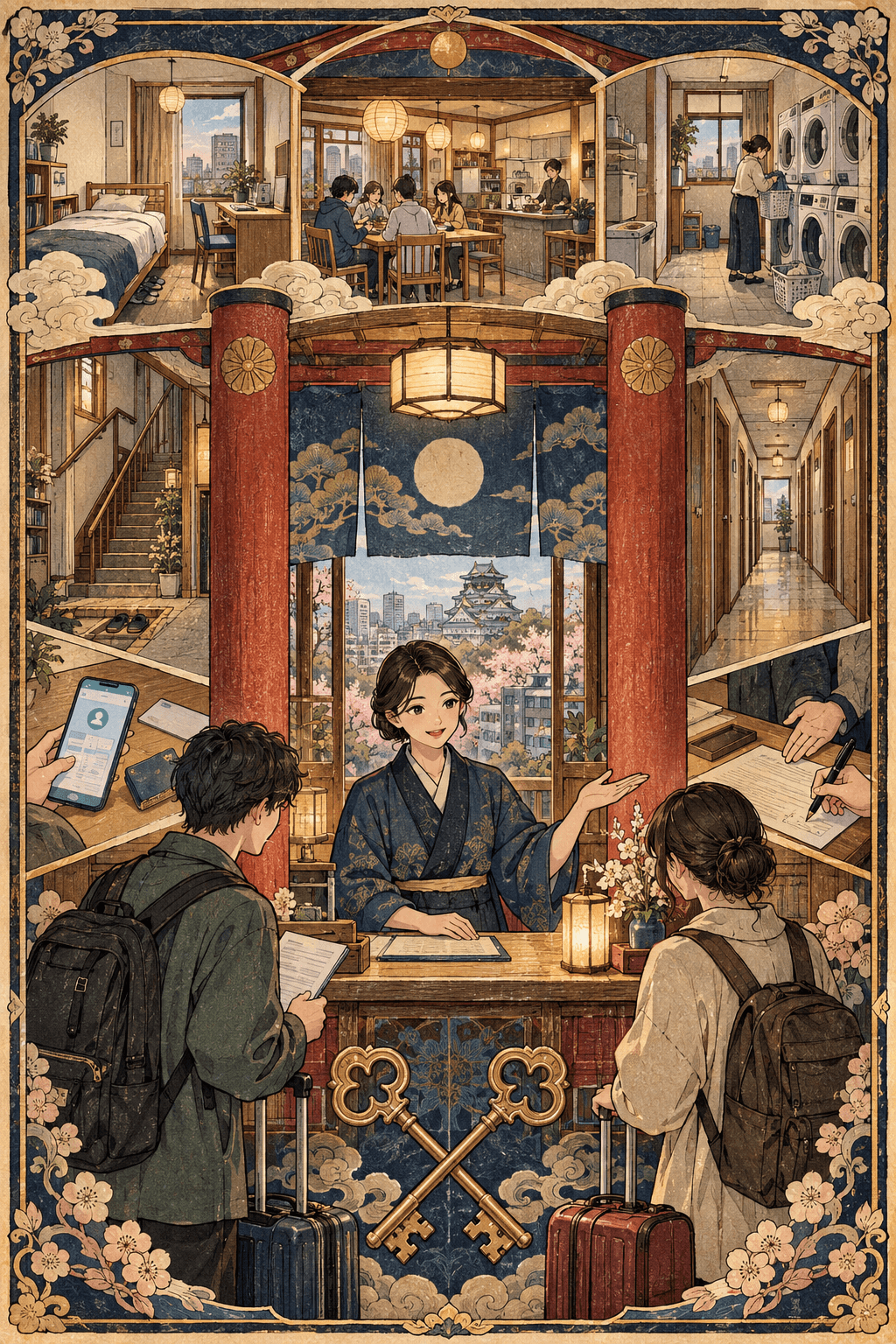
One of the dormitory providers that works with Study In JAPAN ∞ PATH is the Kyoritsu Maintenance group. It reportedly has more than two hundred properties across Japan, chiefly rented to students and working adults, and some of its dormitories are reserved for women.
The building where I am staying is for female residents only.
My place in Osaka is a studio with meals included. The charges cover an application fee, building maintenance, rent, meals and internet. When I divide the cost of three months in a room of just over ten square metres, the average monthly rent comes to roughly the same as a student apartment in a medium-sized German city.
In Germany, that average rent could get you a somewhat larger one-room flat. The trouble with renting in Germany, however, is that you may end up with a place that has no furniture whatsoever. You still have to sign separate contracts for water, electricity and internet, and some flats do not even have a kitchen, so you have to install one yourself.
Of course, ready-to-move-in flats and rooms have become increasingly popular in Germany too, but whether you can actually get one is another matter entirely.
Because I am only here for a short stay, my main consideration was simply whether the accommodation was close to the school. Once I had confirmed that it really was not far away and that the dormitory had a vacancy, I paid soon after receiving the invoice.
The payment information included a notice in Chinese stressing that the sender had to cover all international transfer charges. Otherwise, any shortfall would have to be made up later.
The agency explained that even when someone making a transfer from Taiwan selects “all fees paid by sender,” the amount received in Japan is still usually short. The suggested solution is either to send extra and have the Japanese side refund any excess, or to pay the difference in person after arrival.
As far as I know, Taiwan's banking system also encounters “certain difficulties” in international transactions. When I transferred the money from Germany, I selected the option to cover all fees. I decided I would wait and see whether anyone asked me to settle an overpayment or shortfall. (A note from later: when I signed the contract in person, Kyoritsu said nothing at all about any difference, so I took that to mean the full amount had arrived.)
After the dormitory received the money, another set of documents arrived instructing residents to download an app-based management system. All communication with the dormitory, meal reservations, residence rules, and information about moving in and out goes through this app.
The app is entirely in English. After downloading it, I played around with its features and was extremely impressed by how smoothly it worked. If tens of thousands of rooms are being run through this system, the administrative costs it saves and the gains in efficiency must be astonishing.
Residents are required to arrive for check-in no later than five in the afternoon. For meals, the dormitory app recommends reserving a month at a time so the kitchen can plan its preparation.
Residents must also report any nights spent away. Only relatives or friends of the same sex are allowed to stay overnight, no more than three times a month and for no longer than three days each time.
Bed linen can be exchanged up to three times per month. Refrigerators, televisions and induction cookers can be rented separately, although there was already a refrigerator and an induction cooker in my room when I moved in.
I had considered renting a television, but after living in Germany for twenty years, I have developed the habit of not watching TV. I can watch Japanese programmes online anyway, so it did not seem particularly necessary. I let it go.
Japanese buildings do not always display their street numbers, and I went to the wrong building when I first checked in. Anyone who will be staying at “Dormy Nishi-Nagahori” should therefore look carefully for the Shiragabashi bus stop.
The building behind the bus stop is the correct dormitory. Since the ground floor is a parking area, the proper entrance is reached by climbing the narrow staircase alongside it.
There are parcel lockers at the entrance. After entering the dormitory, residents remove their shoes and put them in a shoe cabinet. The management office is on the right just inside the entrance, and visitors have to register there.
Residents tap a chip card whenever they enter or leave, much like clocking in and out of work.
The individual rooms, however, still use traditional keys.
Although the dormitory guide in the app says that dormitories have communal baths, the Nishi-Nagahori building does not have one. Each private studio simply has a very small bathroom with a small bathtub.
Apart from the management office, the second floor has a dining hall and a kitchen where residents may cook for themselves after registering in advance.
The dining hall also has a water dispenser, a hot-water boiler and a microwave. Anyone who uses the kitchen must clean it afterwards and sort out their own food scraps and rubbish. No cooking utensils are provided, either, so if you want to cook for yourself, you first need your own pots, pans, bowls and plates.
That made me feel rather “foresighted” for bringing a scouring pad, a cleaning cloth and some salt. Japanese supermarkets have so many fresh ingredients. As a food lover with poor cooking skills whose only standard is “if it is cooked through, it is edible,” I genuinely want to buy all that fresh food, cook it and eat it XD.
Still, I have already paid for my meals, and there is no refund if I skip them. I am a picky eater, though. Breakfast offers a choice between Japanese and Western styles, while dinner comes in only one version, alternating between Japanese and Western food.
After two days, I have to say that the Japanese meals are delicious and the Western ones are terrifying.
To eat in the dining hall, residents first check in through the app and show the confirmation image. Side dishes are taken on a self-service basis, while the kitchen prepares and hands over the main dish.
After eating, each person has to clear their own place and give the dishes a quick rinse before putting them into the washing area.
Overall, aside from a faint air of “communal management,” more than ninety per cent of life in this dormitory is arranged much as it would be if you were renting a place on your own.
The vacuum cleaner is shared, but every other cleaning supply has to be bought and every bit of cleaning done by the residents themselves. For students living away from home for the first time, that must take a great deal of getting used to.
My concern is simply that, as a short-term resident staying for only three months, I would have to buy so many cleaning tools and detergents. If I cannot use them up, I will only leave someone else with the nuisance at the end. I could shamelessly borrow things, but I would first need to know someone to borrow them from. Otherwise, I will have to make a little effort and see whether I can find small packages.
After all, there is not even a toilet brush in the bathroom!
Residents also have to buy their own laundry detergent, and the laundry room has coin-operated dryers.
But as someone who normally survives on cards and is too lazy even to use cash, what am I supposed to do about drying my clothes?
Fortunately, the weather has been good these past few days, and it is much hotter than Germany. My room's balcony faces the road. It gets plenty of light, though it also gets the full force of the afternoon sun.
So what do you do without a clothes rack?
I turned my attention to the belt I had specially ordered for practising iaidō. And just like that, an improvised clothesline was born.
Shouldn't I be called a little genius of everyday life?
The rules require residents to visit Kyoritsu's management office and sign the physical contract within two weeks of moving in. The appointment has to be booked online, so I arranged to go on the afternoon after my arrival.
Kyoritsu's office is not far from the dormitory, a little over ten minutes away by public transport. From the subway station, it is only a minute or two on foot.
Except that Google Maps once again led me to the building next door, and I wandered around for a while before finally working out which building was the right one.
The reception desk at the entrance and the security gates in front of the lifts have become little more than decoration, so I simply took the lift to the eighth floor, where Kyoritsu's office is located.
After leaving the lift on the eighth floor, Kyoritsu's office is down the corridor on the right.
The door was closed when I arrived, but once I went straight in, I found a room full of people going through the signing procedure.
I had assumed the signing would be one-to-one. It was not. People with roughly the same appointment time were all gathered in one meeting room, and the contracts were standardised. Whether tenants could actually amend any of the terms is something I remain doubtful about.
Still, it was only a short-term contract, and I had not been charged a deposit, so I did not quibble too much.
Only when I arrived did I discover one important problem: I had forgotten my passport!
At first, I thought this was extremely serious.
It turned out that Kyoritsu has already digitised the process. Both the passport and the language-school admission document can be submitted as electronic files through their website.
In that respect, it really is far more advanced than Germany.
When you sign a contract on site, you are usually more or less held hostage by it anyway. I used ChatGPT to translate and explain mine, confirmed that none of the rules were too outrageous, and found that the basic principles were no different from renting independently in Germany: any changes to the interior required permission and had to be restored afterwards.
The room also had to be cleaned before moving out, or additional charges would be imposed.
That reminded me that I had forgotten to photograph the room when I moved in, and the manager had not given me an inventory form. At that point, all I could do was rely on trust.
The contract comes in two copies. Once the signatures are complete and the identity documents and proof of school admission have been uploaded, that is the end of the procedure for a short-term resident. As for whether Kyoritsu really is a good major landlord, ask me again in three months!
讀者留言