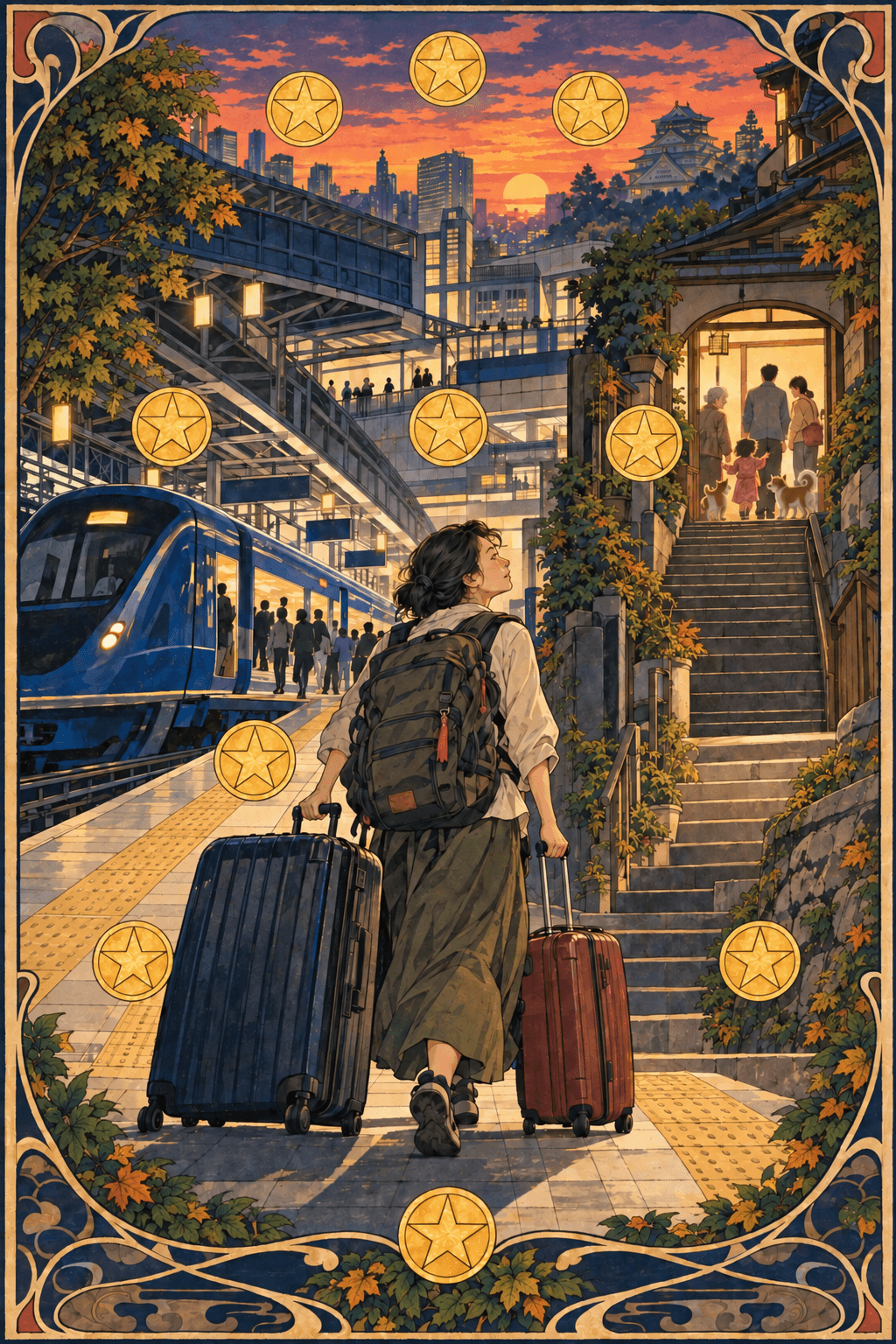
The flight to Japan was fairly empty, but the unfamiliar middle-aged man had ruined my plan to lie flat and sleep. I had no choice but to try to doze uncomfortably in the cramped space, while the man snored in his seat.
After landing at Kansai Airport, I rushed straight towards immigration without pausing for breath. I remembered Kansai Airport as a place packed with people, where the queue alone could sometimes take more than an hour.
I walked quickly and did not dare linger before reaching the point where arriving passengers were divided into different lines. The previous renovation work had been completed. Since handwritten arrival cards were still accepted, people were separated before immigration according to whether they already had a QR code or a paper card.
Those who had preregistered online were directed to kiosks to “check in,” scan their passports, provide fingerprints, and have their photographs taken. Afterwards, each person appeared to be assigned at random to Group A, B, C, or D and directed to a staffed inspection counter.
Each staffed immigration counter displayed which group it was handling. The officer carefully checked the passport’s security features before affixing the landing permission sticker. None of the questions I had expected, nor any examination of my reasons for short-term language study, ever materialised. After a brief exchange of greetings, I officially set foot on Japanese soil. The baggage carousel screen still showed that the luggage was being transported, and the baggage hall was truly packed with people.
I thought I might still have a long wait ahead of me. In Frankfurt, waiting anywhere from half an hour to an hour for baggage is entirely possible. I kept checking my watch and calculating: there was roughly an hour until my reserved train arrived. Surely I could still catch it?
Then, in the very next moment, I saw my suitcase placed neatly on the carousel. Every piece of luggage lay tidily on its side. It was utterly different from most European airports, where bags lie in disarray on the conveyor, sometimes crash into one another as they emerge, or land heavily against the carousel barrier.
In my hurry to catch the train, I did not stop to look more closely. I took my suitcase, loaded it onto a trolley, and headed towards the staffed customs checkpoint.
This was when the group assigned by the entry kiosk came into play. Everyone had to proceed to the gate corresponding to their group. If you had forgotten whether you belonged to A, B, C, or D, a large facial-recognition monitor would mark your face on the screen, then show an arrow telling you which group was yours.
Facial-recognition technology, championed and implemented so thoroughly by China: I wonder when this particular method will spread to every security institution and venue in the world as well?
The Terminal 1 arrivals hall was long, narrow, and not very large. I wandered around once without finding an ATM, then thought, Never mind. I could withdraw money after reaching the city; surely I would not need cash before then. So I pushed my trolley onwards to the railway station.
Unexpectedly, perhaps because this was Terminal 1, the railway station was very close. I had bought my ticket in advance and activated my eSIM, so I brought up the QR code, scanned it, and went straight through the gate.
I realised that I had cleared the airport almost a full hour earlier than expected. My God, I was already at the station! The next train would arrive in little more than ten minutes. Should I change my reservation, or wait fifty minutes for the train I had originally booked?
To hell with it! I opened the app I had used to book the train and discovered that I really could change both the departure and my reserved seat without pain, and without visiting a staffed counter at all. I was delighted. Eight minutes before the train arrived, I had saved myself half an hour. Then I spent another three minutes wondering whether I should queue at Platform 1 or Platform 2, and trying to find where the carriage numbers were written.
Osaka was hotter than I had expected. The moment I entered the carriage, cool air-conditioning greeted me, and I watched the tiny, miniature houses outside the window.
Ah, Japan, Japan. This time I had come here to pretend to live here for a while.
For this journey I had brought one large suitcase weighing twenty-three kilograms, one fourteen-kilogram carry-on suitcase, and a seven-kilogram backpack. The suitcase wheels rolled well, but perhaps because of the weight, they caught every time they met the tactile paving. Namba Station was still some distance from the metro. Pushing the luggage up and down, looking left and right, I could not stop sweating.
Only then did it suddenly occur to me why my husband hoped I could meet him at the airport when he came to visit me in Japan. My husband is a frequent flyer too, I thought. How could he possibly be incapable of handling the journey from the airport into the city? Besides, I did not yet know my language-school timetable and genuinely could not promise that I would be able to meet him. Was my husband being coy with me?
As I walked through the underground passage from Namba Station towards the metro, I suddenly understood my husband’s “advance panic.” The most conspicuous parts of every sign were, without exception, kanji and kana!
Before reaching the dormitory address, I thought I had already arrived at the correct place. The managed entrance, the room notices posted outside, the wording about a management association, and the listed prices all resembled the information I had seen online. Yet I could not find the management office. There was no time to waste, so I bought Rakuten Viber credit and called them.
The person at the management office did not speak English. After a long exchange in which neither of us understood the other, I hurriedly messaged the agency for help. I was certain I was standing at the location marked on Google Maps, and with no visible street number on the building, I had no way to tell whether I had gone to the wrong address.
Osaka was very hot on the afternoon of September 30, 2026. My mind was drifting.
I tried pushing my luggage back along the road for a few more steps. Then, in the car park of a building, I suddenly saw a long, narrow staircase bearing the name of the accommodation.
At last, I thought, overwhelmed with relief.
But with a body exhausted from too little sleep, carrying a twenty-three-kilogram suitcase was truly, truly arduous. There was no lift along this stretch at all, just as so many entrances and exits had no lift when I changed trains in the metro.
When it is time to go home, I am definitely taking a taxi straight to the airport.
Thank goodness. I had finally arrived, and I was so tired.
讀者留言