I set off for the airport. The traffic jam I had expected never materialised.
I took the SkyLine from Terminal 1 to Terminal 3.
More than twenty years ago, to board the SkyLine from Terminal 1, you had to walk to the middle of the terminal and go upstairs at an inconspicuous corner. Now the brand-new station is at the end of the long corridor that leads out from the car park and railway station, then around the corner to the left.
The newly opened Terminal 3 truly is some distance from Terminal 1. The SkyLine journey felt as though it took at least seven or eight minutes.
Perhaps it is because so many non-German-speaking travellers have poured into Europe over the past few years. When I walk alone through the airport with my Asian face, the staff now generally address me in English straight away.
It was not like this before. Back then, as a frightened youngster who could not speak German, I often had staff address me in German without the slightest hesitation.
As Frankfurt grew increasingly international, I also became almost entirely integrated into local German life. To be automatically sorted, on account of my appearance, into the category of “foreigner who does not speak German” is a peculiar feeling.
It is a little as though this place once wanted me to hurry up and become part of it. Now that I have become part of this place, assumptions based on my appearance turn me once more into someone who does not belong here.
I do not say this in reproach. I am merely struck by how strange the workings of the human mind can be.
Terminal 3 uses a fully automated, unattended check-in system. Every passenger has to print their own boarding pass and baggage tag at a machine, attach the tag themselves, then push their luggage onto the conveyor belt on their own.
The traditional staffed counters of the past have disappeared. Has Germany finally begun to enter the great age of automation as well?
My immediate thought was: the airlines can save quite a bit of labour this way!
Even passing through border control has become an almost entirely automated process.
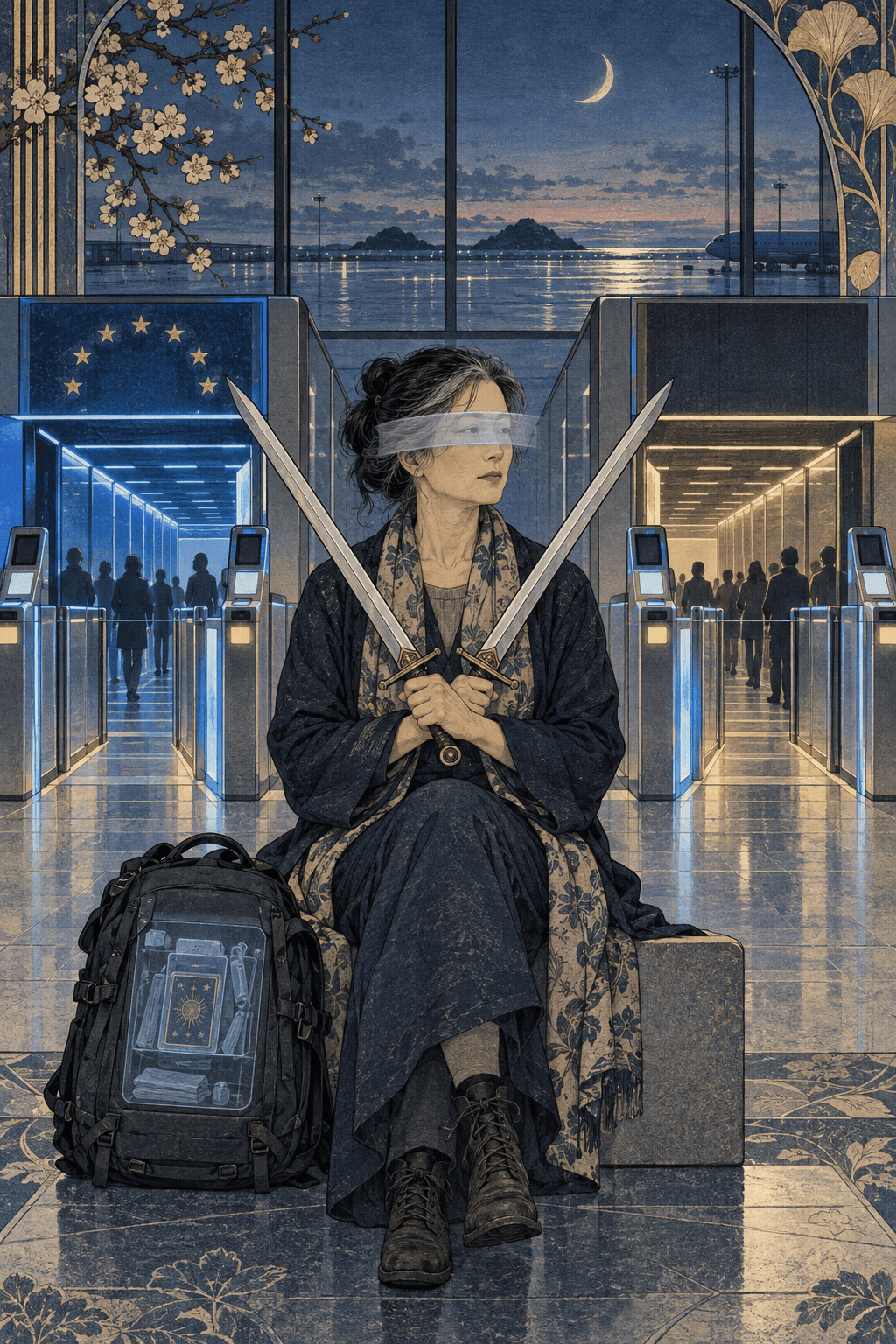
The border-control lanes still follow the traditional division, directing EU citizens and holders of residence status into different lanes from travellers carrying third-country passports.
The queue for third-country passports was long and tightly packed. With my head lowered, I walked straight ahead “without the slightest hesitation,” making for the lane marked with the ring of European stars.
Yet, because of this Asian face, a member of staff kindly reminded me, “The lane ahead is for the EU.”
Almost no one was using the EU lane. There was no queue at all when I reached the machine: one scan of the passport, one photograph, and the gate opened. Although a human border officer was still stationed beyond it, the officer in the EU lane was little more than decoration. As I passed, the officer was talking to a colleague. Without our eyes meeting even once, I was through border control.
At that moment, I did feel the faintest hint of being treated as one of their own. I wanted to indulge myself with the thought: I am an industrious, conscientious, upstanding citizen of the EU.
Frankfurt Airport has also upgraded and strengthened its security-screening equipment. There is now no need to remove electronic devices or liquids from hand luggage. Once the machine scans each item, it automatically separates baggage that requires an additional check from baggage that does not.
Just before it was my backpack’s turn to enter the machine, the scanner in my lane broke down. The security staff had to restart it before they could resume scanning.
So the travellers could only wait and wait. Fortunately, the malfunction was quickly resolved. After about five minutes, the machine was running again, and I watched helplessly as my backpack was routed onto the conveyor for baggage requiring inspection.
Of course I had been selected for inspection before. On those occasions, however, the staff would usually ask me to open the backpack myself and take out whatever item had been flagged as a possible problem.
This time, the security officer told me that I was not allowed to touch the backpack until he had finished inspecting it. He put on gloves and opened it himself. I felt slightly embarrassed. The chaos inside my bag was almost too much to look at.
I had assumed that the toothpaste or facial cleanser in my toiletries bag might have been flagged because of its stated capacity. In the past, that rule had forced me to throw away two bottles of toner at security: the bottles were marked 120 ml, even though only a small amount remained inside.
The toothpaste I had brought this time also seemed to be marked 120 ml, although only a third of it was left.
As it turned out, neither the toothpaste nor the facial cleanser was the problem.
From deep inside the backpack, the officer pulled out a cloth pouch. When he opened it, even he seemed slightly surprised: inside was a deck of tarot cards. He then explained that the machine likes to flag cards. Playing cards and UNO, for example, are almost always selected for inspection.
In my own private imagining, I wondered: do drug traffickers or illegal smugglers like to disguise contraband as game cards?
I entered the brand-new departure lounge. There were not many travellers, and the space was large, so it felt comfortable overall, unlike some crowded airports. Nor were there all that many shops.
The layout of the lounge reminded me of Shanghai Pudong Airport; there were similarities in both its structure and arrangement. I ordered a coffee and a croissant and waited until the airport announcement said that the gate for our flight was ready and passengers could proceed there.
I shouldered my backpack and slowly strolled towards the gate.
讀者留言